
Overview of the Kimi 2.5 Model
Kimi 2.5 is a frontier-level, open-source multimodal model. Unlike many models that specialize in just one area, Kimi 2.5 is designed to be a “jack-of-all-trades” with a specific focus on agentic behavior—the ability to use tools, browse the web, and execute code to solve complex problems independently.
Built on a massive scale, it was trained on approximately 15 trillion mixed visual and text tokens. This “native multimodal” approach means it doesn’t just translate images into text to understand them; it perceives pixels and prose in the same unified brain.
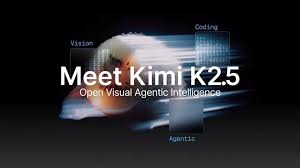
Key Features and Improvements
Kimi 2.5 isn’t just a bigger version of its predecessors; it’s smarter and more efficient.
- The Agent Swarm (The Showstopper): This is Kimi’s “superpower.” While a standard AI handles a task step-by-step, Kimi 2.5 can self-direct a “swarm” of up to 100 sub-agents. These agents work in parallel—one might research a topic, another writes the code, and a third audits the results—completing tasks up to 4.5x faster than a single agent.
- Mixture-of-Experts (MoE) Architecture: Kimi 2.5 features a staggering 1 trillion total parameters, but it uses a clever MoE design. It only activates about 32 billion parameters for any specific request. This makes it incredibly powerful yet efficient enough to run with lower latency and cost.
- Massive Context Window: With a 256k token context window (roughly 200,000 words), Kimi can “read” and remember several thick novels’ worth of information in a single session.
- Four Specialized Operating Modes:
- Instant: For lightning-fast, simple queries.
- Thinking: Uses “Chain of Thought” reasoning to show its work (ideal for math and logic).
- Agent: A single agent focused on using tools like web browsers or code interpreters.
- Agent Swarm: The full-throttle parallel processing mode for massive projects.
Use Cases and Applications
Kimi 2.5 shines in scenarios where you need an assistant to do work, not just talk about it.
Coding with Vision
Imagine recording a 30-second video of a website and telling Kimi, “Build this.” Because it understands video natively, it can reconstruct functional front-end interfaces, including interactive layouts and animations, directly from visual input.
Deep Academic Research
Kimi can browse the live web, download dozens of academic papers, and synthesize them into a structured literature review. It doesn’t just summarize; it cross-references data points across sources to ensure accuracy.
Professional Asset Creation
One of its most practical features is “Agentic Slides.” You can ask it to “Research the top 10 luxury car trends and build a 20-slide presentation,” and it will scrape the data, generate the charts, and produce a branded, editable PowerPoint deck.
Advantages and Potential Limitations
Every piece of tech involves trade-offs. Here is how Kimi 2.5 stacks up:
The Pros
- Cost-Efficiency: At roughly $0.60 per million input tokens, Kimi 2.5 is significantly cheaper (sometimes up to 95%+) than proprietary models like GPT-4 or Claude 3.5.
- Open Source: Developers can download the model weights and run it on their own hardware, ensuring data privacy and customization.
- State-of-the-Art Reasoning: It rivals the world’s best models in mathematics (96.1% on AIME 2025) and coding.
The Cons
- Hardware Requirements: While it is efficient, running a 1-trillion-parameter MoE model locally still requires a high-end setup (e.g., multiple H100 or B200 GPUs) for peak performance.
- Nuance in English: While excellent in many languages, some users find that it has a slight “accent” or stylistic preference toward Chinese-centric contexts, though its English capabilities remain top-tier.
- Complexity for Beginners: The “Agent Swarm” and tool-calling features require some technical know-how to implement via API, making it a bit more daunting for non-technical users than a simple chat interface.
Conclusion: My Personal Insight
Kimi 2.5 feels like a glimpse into the 2026 “New Normal.” We are moving away from asking AI to write emails and toward asking AI to manage projects. Its ability to coordinate a swarm of agents effectively lowers the barrier for a single person to do the work of a whole team.
In my view, Kimi 2.5’s greatest contribution isn’t just its speed or its vision; it’s the democratization of agency. By being open-source and affordable, it allows startups and independent creators to build the kind of “autonomous employees” that were previously reserved for tech giants.
I liked the way the topic was connected to actual trading decisions.
revenue growth analysis